Choosing a Program
How to Choose an HVAC School in Florida: Seven Questions to Ask First
October 14, 2026 · 7 min read
Every program promises a career in air conditioning. These seven questions show you which ones actually prepare students — and which ones never let you charge a system.
Most HVAC programs describe themselves the same way: hands-on training, experienced instructors, career support. The differences only show up when you ask specific questions. If you are comparing schools across Miami-Dade, Broward or Palm Beach County, use the seven below in the same order with every program on your list.
1. How much of the week is spent with tools in your hands?
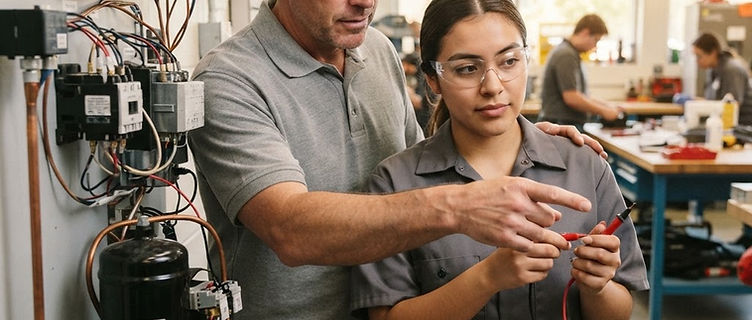
Every school advertises hands-on training. The real question is the ratio. Ask what percentage of class time happens at a training wall, on a live condenser, or with gauges and a vacuum pump in your hands — then ask to see the lab.
If the honest answer is "a slide deck and a textbook," you will spend your first months on the job learning what you should have practiced in class.
2. Are the instructors still working in the field?
A technician who serviced a system last week explains a diagnosis differently from someone who last touched a unit a decade ago. Ask how many hours a week each instructor still spends on service calls, and which equipment they work on.
3. Does the program cover repair, installation and maintenance — or only one?
Entry-level work rarely arrives as a single tidy task. A technician may diagnose a frozen coil in the morning and help set a new air handler in the afternoon. Look for a curriculum that covers all three, with diagnostics treated as a subject of its own.
- Repair: reading pressures, finding leaks, testing and replacing components
- Installation: line sets, brazing, evacuation, charging and airflow
- Maintenance: cleaning, testing, and catching failures before they become emergencies
4. Is EPA 608 certification part of the program?
You cannot legally handle refrigerant without the card, and most employers will not send a technician on a service call without one. A serious HVAC School Florida program prepares you for the EPA 608 exam inside the course, not as an optional extra you pay for later.
5. Does the training match South Florida equipment and climate?
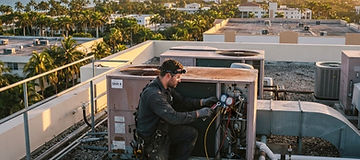
South Florida is a cooling market. Systems run most of the year, humidity control matters as much as temperature, and heat pumps, mini-splits and packaged rooftop units are everywhere. A program built for a northern heating market will spend weeks on furnaces you might rarely open here.
6. Can you keep your job while you study?
Many students train while working full time. Ask about class times, whether lab hours are flexible, and how much practical work can be repeated outside scheduled sessions. A schedule that assumes you are free on weekday mornings quietly excludes most people who need the training.
7. Can you speak to recent graduates?
Not a testimonial on a website — an actual conversation. Ask where graduates are working now, how long it took to find a first job, and what they wish the course had covered. The answers tell you more about a program than any brochure.
How HVAC School Florida answers these questions
HVAC School Florida is built around the practical side of the trade: gauges, meters and real equipment from the first week, instructors who still work in the field, and training focused on the cooling systems that dominate South Florida.
If you are still comparing, request the program details by email and ask the same seven questions of every school on your list. The differences become obvious very quickly.
Written by the HVAC School Florida team · contact@hvacschoolflorida.sbs