Careers
HVAC Careers in South Florida: Why Trained Technicians Stay in Demand
November 5, 2026 · 6 min read
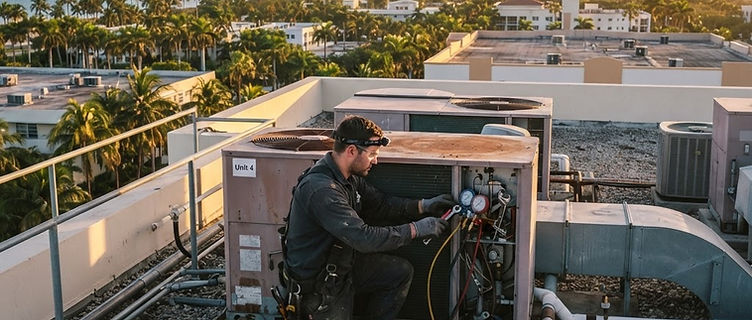
In most of the country air conditioning is seasonal. In South Florida it is a year-round trade — and that changes what employers hire for.
In most of the country, air conditioning is a seasonal business. In South Florida it is a year-round one. That single fact shapes what the work looks like, what employers hire for, and how quickly a trained technician can find a first job in Miami-Dade, Broward or Palm Beach County.
A market that never stops cooling
Cooling season here does not end in September. Systems run through October, November and often December, and the humidity means a unit that is technically working can still leave a house uncomfortable. Maintenance visits, emergency calls and replacements continue through the year, so demand for technicians does not collapse with the temperature.
Residential service or commercial work
Entry-level technicians usually start in residential service and maintenance, where the equipment is smaller and the call volume is high. Commercial work — packaged rooftop units, chillers, split systems in offices and restaurants — tends to pay more and usually comes after a year or two of experience.
Neither path is closed to a new graduate. What matters is that your training covered both single-phase residential equipment and the three-phase systems found in commercial buildings.
What employers look for when hiring
- EPA 608 certification — a legal requirement to handle refrigerant and a filter most employers apply before the interview
- Comfort with a multimeter and a gauge manifold, not just the theory behind them
- A clean driving record, since service work means driving a company van
- Reliability and clear communication — customers are letting a technician into their homes
- Willingness to keep learning: equipment, controls and refrigerants keep changing
Certifications that open doors
Beyond EPA 608, manufacturers run their own equipment training, and there are specialty certifications for heat pumps and building performance. None of them replace experience, but each signals to an employer that you are investing in the trade.
An HVAC School Florida program should prepare you for the EPA 608 exam inside the course, so the card is in hand before you start applying.
From training to first job: a realistic timeline
Many students move into helper or maintenance roles while still finishing their training, then into full service work as their diagnostics improve. The first year is about volume: as many different systems, faults and installations as you can get your hands on. The technicians who advance fastest are the ones who ask why a system failed, not only how to swap the part.
Is HVAC a good career in Florida?
For someone willing to work outdoors, use tools and keep learning, it is one of the more stable trades in the state: the equipment is everywhere, the climate guarantees work, and the skills travel with you.
Written by the HVAC School Florida team · contact@hvacschoolflorida.sbs