Inside the Program
What You Actually Learn in Your First Months at an HVAC School in Florida
October 27, 2026 · 6 min read
A syllabus lists topics. It does not tell you what you will be able to do. Here is what students at an HVAC School Florida program can handle by the end of the first three months.
Every program publishes a list of topics. What matters more is what you can do with your hands at the end of each week. Below is how the first twelve weeks of an HVAC School Florida program are actually structured, from safety to live diagnostics.
Week one: safety, tools and the refrigeration circuit
Before touching a system you learn how it can hurt you: refrigerant under pressure, live disconnects, and a brazing torch in a small space. Then the circuit itself — compressor, condenser, metering device, evaporator — and what each component does to the refrigerant.
By the end of the week you should be able to identify every component on a split system and explain the path the refrigerant takes through it.
Weeks two and three: pressures, temperatures and superheat
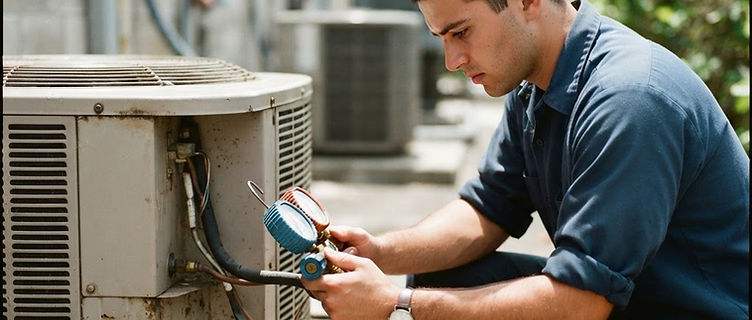
This is where most students discover that air conditioning is a measurement trade. You connect gauges, read suction and liquid pressures, take temperatures at the coil, and calculate superheat and subcooling instead of guessing.
Charging a system by feel is how units get overcharged and coils ice up. Charging by numbers is the difference between a technician and someone holding a set of tools.
Weeks four to six: electrical troubleshooting
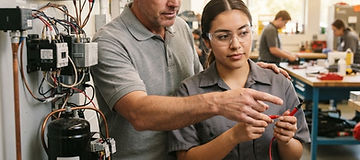
Most service calls end in an electrical answer: a failed capacitor, a pitted contactor, a control board that will not close, a breaker that keeps tripping. You learn to read a wiring diagram, use a multimeter safely, and trace a circuit from the thermostat to the component that is not doing its job.
Weeks seven to nine: installation, line sets and airflow
Installation is where callbacks are born. You practice brazing, pressure testing, pulling a proper vacuum and charging by weight — and, just as important, airflow: duct sizing, static pressure, and why a perfectly charged system still will not cool a room when the return is undersized.
Weeks ten to twelve: diagnostics on live equipment
By this stage the exercises stop being tidy. An instructor introduces a fault without naming it. You measure, reason, commit to a diagnosis, repair the equipment and prove the system works again. This is the closest thing to the job itself.
What still takes time after class
Speed comes from repetition, and no program can compress years of service calls into a few months. What good training gives you is a method: measure first, reason second, replace parts last. An employer can teach you their paperwork and their inventory. They cannot easily teach you how to think through a no-cooling call.
Written by the HVAC School Florida team · contact@hvacschoolflorida.sbs